
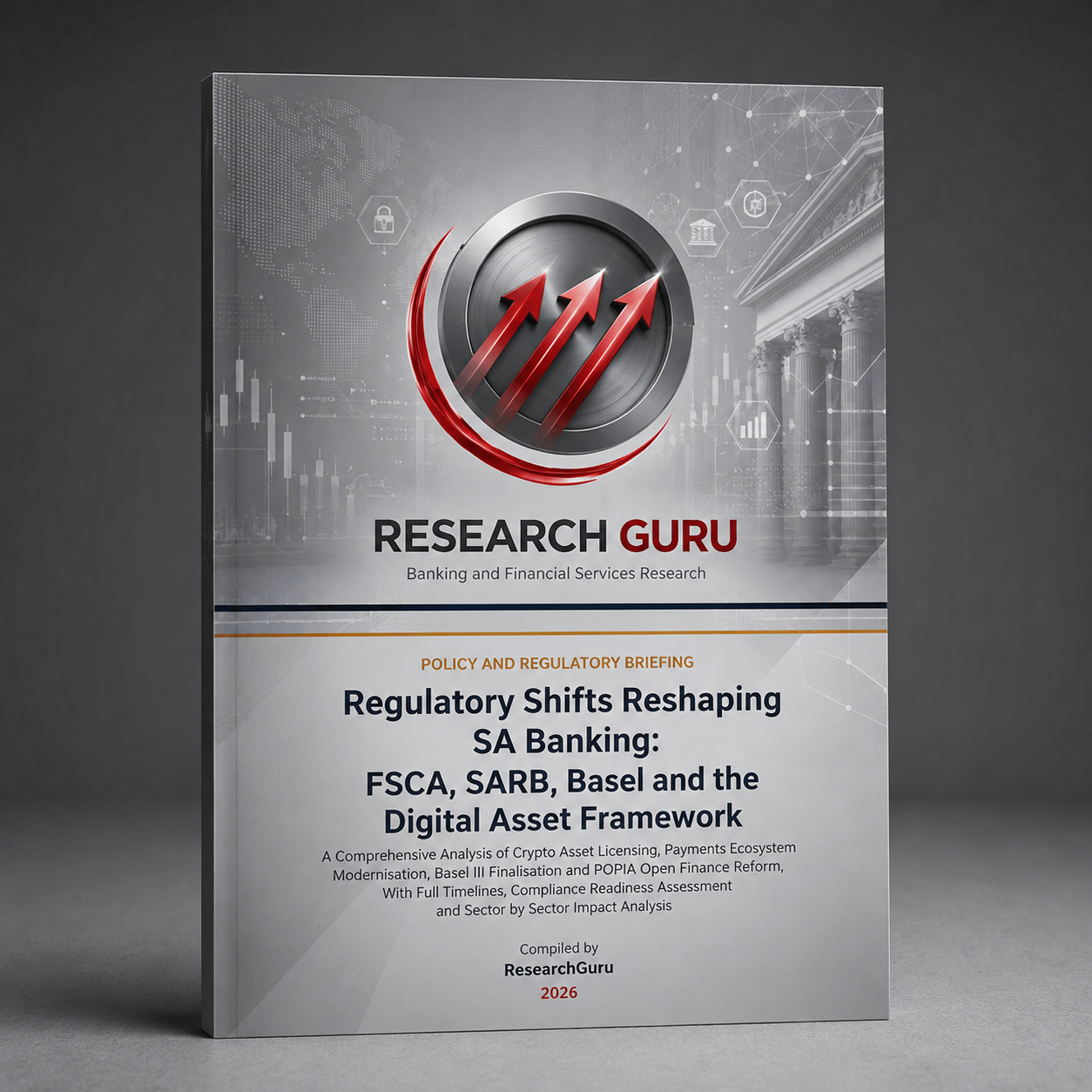
Description
Most regulatory briefings cover one reform in isolation, a crypto licensing note here, a Basel III readiness memo there. That approach misses the point: South Africa’s financial regulators are running eight major reforms at once, and every one of them shares systems, data, and governance dependencies with the others. Regulatory Shifts Reshaping SA Banking treats those connections as seriously as the individual reforms themselves, and gives you the full picture in one document instead of five.
At the centre of the report is a compliance readiness assessment scoring each reform on implementation complexity and estimated compliance cost by institution type, and a sector-by-sector impact analysis comparing how systemic banks, digital-first banks, fintechs, crypto asset service providers and insurers are each affected differently by the same underlying reform agenda. Nothing else on the market brings these eight reforms together in one consistently structured, cross-referenced document.
What’s inside
South Africa’s Twin Peaks regulatory architecture, explained end to end, covering National Treasury, the SARB, the Prudential Authority, the FSCA, the Financial Intelligence Centre, and the Corporation for Deposit Insurance. Full treatment of the FSCA crypto asset licensing regime, including licensing volumes and growth from 2023 to 2026, ongoing compliance obligations, the Crypto Asset Reporting Framework, VALR and Luno compliance case studies, and a comparative table against the EU, UK, Nigeria and Kenya’s licensing models. Complete coverage of the SARB’s Payments Ecosystem Modernisation programme, including the non-bank direct access framework and a regulatory reading of PayShap. Basel III finalisation in full, covering the SARB’s implementation timeline, the output floor phase-in schedule, capital ratio impact assessment across the five largest South African banks, and an international timeline comparison against the UK, EU, US and Australia. POPIA and the Open Finance agenda, including Information Regulator enforcement trends and an international maturity comparison against the UK, Brazil, India, Nigeria and Kenya. The Conduct of Financial Institutions Bill and what its activity-based model means for banks, insurers and fintechs. AML/CFT reform and South Africa’s FATF greylist exit. The JIBAR to ZARONIA benchmark transition. Exchange control modernisation and the draft Capital Flow Management Regulations. Cybersecurity and operational resilience regulation. A full compliance readiness assessment scoring all eight reforms. A sector-by-sector impact analysis across five institution types. A complete regulatory timeline table running from 2020 to 2029. A glossary of regulatory terms. A compliance checklist organised by institution type, ready to use as a starting point for your own internal gap analysis.
Who this is for
- Chief Risk Officers, Heads of Compliance, and regulatory affairs teams at banks, insurers, and payment service providers.
- Crypto asset service providers managing FSCA licensing and CARF reporting obligations. Fintechs assessing their exposure to the Payments Ecosystem Modernisation programme and the COFI Bill.
- Corporate strategy teams and investors assessing regulatory risk and compliance cost across the South African financial sector.
- Legal and advisory firms needing a consolidated reference across all eight reforms.
Format and delivery
Delivered as a professionally designed PDF, instantly downloadable on purchase. Send any queries to info@researchguru.co.za.
Publisher: ResearchGuru.
Report type: Policy and Regulatory Briefing.
Pages: 49.
Geographic scope: Republic of South Africa, with Basel Committee, FATF and comparative international references.
Format: PDF, digital download.
Publication date: August 2026.
Referencing style: Harvard. Language: English.

Reviews
There are no reviews yet.